The Ouroboros Economy: Circular Financing in the AI Buildout and Who Holds the Risk
Abstract
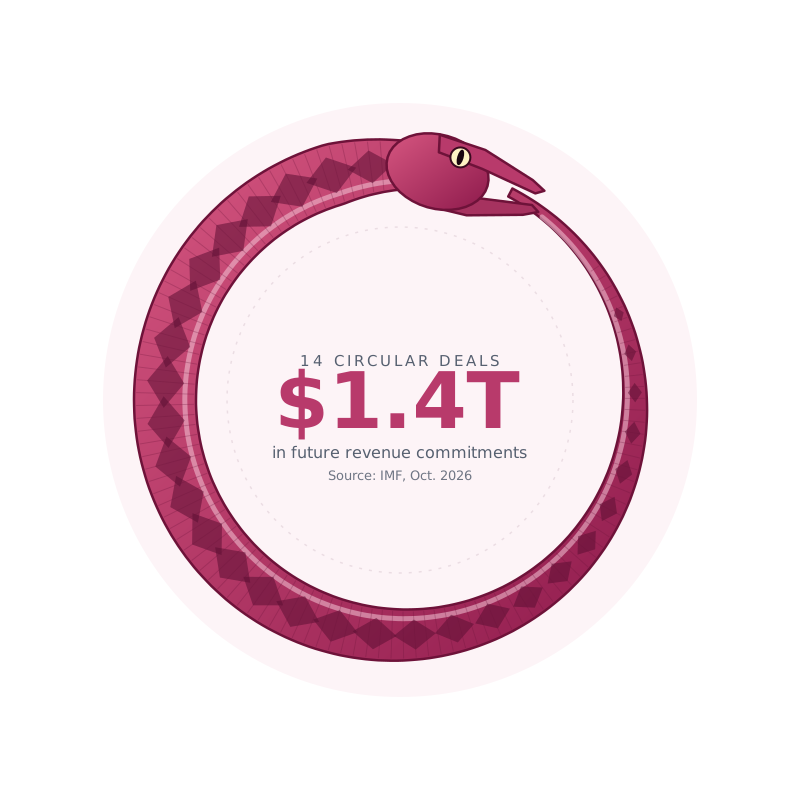
The largest technology companies in the world are paying for the artificial intelligence buildout in part by funding each other’s customers. A chipmaker invests in an AI lab; the lab commits to buy the chipmaker’s chips, or a cloud company’s capacity, which in turn buys the chipmaker’s chips. The International Monetary Fund counted 14 such transactions since 2023, involving about $300 billion in equity, about $650 billion in debt, and $1.4 trillion in future revenue commitments. This paper maps the loop, measures its size with data available as of November 5, 2026, tests the strongest arguments that it is not a problem, and identifies where the risk actually sits.
The central finding is that the ouroboros metaphor is useful but incomplete. The loop is real, and it makes reported revenue and backlog look stronger than independent demand alone would. But the system is not closed: it is increasingly fed by outside money, especially bond markets, and the weakest points are not the best-capitalized chipmakers and clouds. They are the highly leveraged builders who stand between a very large commitment and a company whose revenue is still a fraction of what it has promised to spend.
Key judgments
- Circular financing is a material feature of the buildout, not a side show. High confidence The IMF’s October 2026 review found about $300 billion in equity investments and about $650 billion in debt in 14 transactions, in exchange for $1.4 trillion in future revenue commitments.
- The loop is not closed, and that cuts both ways. Moderate confidence External cash is entering through operating cash flow, record bond issuance, and investors in private rounds. That makes a pure “snake eating itself” collapse unlikely, but it also means that stress can move into credit markets and pension, insurance, and bank portfolios.
- The self-funding capacity of the biggest spenders has deteriorated sharply. High confidence Combined trailing free cash flow at Amazon, Alphabet, Meta, and Microsoft fell to $62.4 billion in the third quarter of 2026, from $209.1 billion a year earlier, while 2026 capital spending guidance sits at $720 to $740 billion.
- The most exposed link is the gap between OpenAI’s commitments and its revenue. Moderate confidence OpenAI’s annualized revenue was approaching $50 billion at the end of September 2026, against more than $1 trillion in reported compute commitments and a reported $278 billion of projected cumulative negative free cash flow from 2026 through 2030. The companies that built capacity for it, and their lenders, hold the downside.
- A disorderly correction is a minority outcome, but not a remote one. Low confidence I assess roughly a 25 to 35 percent chance, over the next 24 months, of an AI-linked repricing severe enough to force the cancellation or restructuring of announced compute contracts and to tighten credit conditions noticeably. This is an analytic judgment, not a forecast, and the indicators in Section 7 should move it.
1. What circular financing is, and why a snake
Circular financing is any arrangement where a supplier provides money, whether equity, loans, guarantees, or credits, to a customer, and the customer uses that money to buy the supplier’s products. A related and equally important form runs through the middle: a cloud company signs a large contract with an AI lab, borrows to build the capacity, and spends the proceeds on the chipmaker that is itself an investor in the lab.
The ouroboros fits because the head is feeding on the tail. Each company can report real revenue and real investment, and every individual contract can be legal and disclosed. The concern is that the same dollar can appear as revenue or backlog at more than one stop on the chain, so reported demand may overstate independent demand. The IMF put it plainly: if a key recipient of investment comes under stress, revenue forecasts and investment valuations fall, which weakens the value of the debt that was raised in those deals.
The metaphor also has limits, which Section 5 takes up. A real ouroboros has no source of food other than itself. This system has several.
2. The loop, mapped
| Date | Parties | Terms as reported | Status and notes |
|---|---|---|---|
| Sep 2025 | Nvidia and OpenAI | Letter of intent: Nvidia to invest up to $100B as OpenAI deploys at least 10 GW of Nvidia systems | Never finalized. Nvidia’s November 2025 quarterly report said there was no assurance of a definitive agreement. Replaced in early 2026 by a $30B equity investment inside OpenAI’s larger funding round (reported by the Financial Times). |
| Oct 2025 | AMD and OpenAI | 6 GW of AMD Instinct MI450 chips; warrants for up to 160M AMD shares at a nominal price | Runs in the opposite direction from the Nvidia deal: the supplier gives the customer a stake. Reported valuation of the warrants above $26B at the time. |
| 2025 | Oracle and OpenAI | About $300B, roughly five-year cloud contract | Oracle sold $18B of bonds in September 2025 and planned $45B to $50B of debt and equity financing in 2026. Its credit default swaps reached record highs in late 2025. |
| 2025 | Microsoft and OpenAI | About $250B of incremental Azure spending; Microsoft owns about 27% of OpenAI | Microsoft’s fiscal 2026 annual report discloses $24.1B of revenue from its commercial arrangements with OpenAI, out of $331.8B total (as summarized by secondary sources). |
| Nov 2025 | Anthropic, Microsoft, Nvidia | Anthropic commits $30B to Azure compute and up to 1 GW; Microsoft to invest up to $5B and Nvidia up to $10B in Anthropic | Part of a broader pattern: Anthropic also has large commitments with Amazon and Google. Reported 2026 talks include a further Nvidia investment ahead of a possible IPO. |
| 2026 | OpenAI funding round | Reported at more than $100B, including Nvidia $30B, SoftBank $30B, and up to $50B from Amazon | Investor money from companies that are also OpenAI’s suppliers. Reported valuation $730B before the new money. |
| 2025 to 2026 | CoreWeave and OpenAI | Cloud contracts expanded to as much as $22.4B; CoreWeave also gave OpenAI $350M in equity | Reported by Bloomberg and summarized in commentary. A smaller but symmetrical example. |
| 2025 to 2026 | Microsoft and “neoclouds” | About $60B of commitments with CoreWeave, Nebius, and Nscale | Reported to be booked as operating expenses over the contract life rather than as capital spending on Microsoft’s own books. |
Two features of the map matter. First, several companies appear on both sides: Microsoft and Amazon are investors in and suppliers to the AI labs, and Nvidia is both an investor and the ultimate recipient of much of the hardware spending. Second, not every deal points the same way. The AMD arrangement, for instance, has the supplier giving the customer equity, which is circular in effect but differs in structure.
3. How big is it?
The IMF’s count
The IMF’s October 2026 Global Financial Stability Report is the best available aggregate. Its review of 14 circular transactions since 2023 found roughly $300 billion in equity, $650 billion in debt, and $1.4 trillion in future revenue commitments. The report also finds that hyperscalers now account for about 10 percent of global investment-grade corporate bond issuance in 2026, up from less than 1 percent in 2024, and lists an AI-driven market correction first among three salient risks to financial stability. Press coverage of the report indicates that about $320 billion of the debt sits with the companies receiving the investment; I could not verify that figure in the primary text.
The spenders’ cash is running out
Amazon, Alphabet, Meta, and Microsoft together spent more than $210 billion on capital expenditures in the third quarter of 2026, according to a compilation of their filings by the analyst Charles Fitzgerald. Year-to-date spending exceeds $515 billion. The same compilation shows combined trailing twelve-month free cash flow collapsing to $62.4 billion, down 70 percent from a year ago, with Amazon, Alphabet, and Meta each reporting negative free cash flow in the quarter. Microsoft was the only one still clearly positive, at $18.6 billion.
When internally generated cash falls short, the gap is filled by borrowing. Alphabet, for example, raised $28.7 billion of net proceeds from senior notes in the third quarter, and its capital spending ($51.4 billion) exceeded its operating cash flow ($42.3 billion). This is the channel the IMF is worried about: the loop is increasingly financed from outside the loop, in markets where pension funds, insurers, and banks are the buyers.
4. Where the weak links are
OpenAI: commitments far ahead of revenue
OpenAI sits at the center of the map. Its audited 2025 figures, obtained by independent journalists and reviewed by the Financial Times, show revenue of about $13.1 billion and an operating loss of about $20.9 billion. In October 2026 it told investors that annualized revenue was approaching $50 billion at the end of September, about $20 billion below widely reported figures, a gap attributed to how revenue is counted (net versus gross of cloud-partner sales) rather than to a drop in demand. Reported internal projections show cumulative negative free cash flow of about $278 billion over 2026 to 2030. Against that, reported compute commitments exceed $1 trillion. The company’s president testified that it expected to spend $50 billion on compute in 2026 alone.
None of this means OpenAI will fail. It means the commitments are an act of faith in revenue growth of an extraordinary kind, and every upstream supplier’s backlog depends on that faith being rewarded. When the Financial Times reported the revenue figure on October 8, AI-linked stocks fell, which illustrates how tightly the narrative and the numbers are linked.
Oracle and the leveraged middle
The weakest balance sheets are in the middle of the chain. Oracle’s roughly $300 billion contract with OpenAI represents what one analyst called unprecedented single-customer exposure. Oracle has raised tens of billions of dollars in bonds and equity, banks have financed data centers built by third-party developers with Oracle as the tenant (including a reported $38 billion loan for sites tied to OpenAI’s Stargate project), and Oracle’s credit default swaps reached multi-year highs. Analysts quoted at the time argued that if OpenAI faltered, Oracle would shrink its build-out and write down contracts but would not default. That is a reassuring view for Oracle’s bondholders and a less reassuring one for lenders to project vehicles whose revenue depends on the same contract.
The same logic applies to the neoclouds. The exposure is concentrated in a small number of borrowers whose revenue depends on a very few customers, who are in turn financed by the suppliers.
Related-party backlog and accounting
Backlog, the headline figure investors use to value cloud companies, is only as good as the customer behind it. A South Korean central bank analysis, as summarized by secondary sources and not independently verified here, estimates that circular deals account for 47 percent of Oracle’s cloud backlog and 41 percent of Microsoft’s. Whatever the exact figures, the direction is consistent with the IMF’s warning: a meaningful share of reported forward revenue depends on a handful of related parties. The way contracts are booked matters too. A commitment recorded as an operating expense over a contract’s life, rather than as capital spending, can make a buyer’s balance sheet look lighter than the obligation it has taken on.
5. The case against the snake
A fair analysis has to give the opposing view its strongest form, and there is a serious one.
- The deals are in the open. Most of these arrangements are announced and disclosed, and a buyer of Microsoft stock knows it holds part of OpenAI. Transparency does not remove the risk, but it makes a hidden accounting scheme less likely.
- “Circular” is used loosely. The economist Noah Smith pointed out that the label covers very different structures, and that some deals diversify dependencies rather than concentrate them. OpenAI buying AMD’s chips while holding AMD warrants is not the same as Nvidia buying stock in a customer that spends it on Nvidia chips.
- There is real cash and real demand. Nvidia reported close to $48 billion of free cash flow in a recent quarter. Alphabet’s cloud operating income rose to $11.1 billion in the third quarter from $3.6 billion a year earlier. Amazon’s chief executive said AWS could grow by more than 40 percent in each of 2027 and 2028 and that the company can fund its plan. Customers outside the loop are buying AI services.
- The biggest investors are not small. The companies funding the buildout are among the most profitable in history. A pullback would hurt them but would not necessarily threaten their solvency.
- Executives reject the framing. Nvidia’s Jensen Huang has called the circular-financing label ridiculous, and CoreWeave’s chief executive has said Nvidia’s investment in it is too small to be propping it up.
I find these arguments persuasive on the question of whether the largest companies are in danger. They are weaker on the question the IMF is asking, which is whether a stumble at one node, especially a leveraged one, could spread through the credit system. Evidence of real demand does not answer whether demand is large enough to justify the committed spending, and strong parent-company balance sheets do not protect the lenders to project vehicles and smaller borrowers.
The deeper correction to the metaphor is that this snake is not only eating itself. It is also taking in outside food, in the form of debt. That is why the result is not a tidy implosion but a larger and more interconnected system, with more parties holding claims on the same future revenue.
6. Scenarios
| Scenario | What it looks like | Judgment |
|---|---|---|
| Growth catches up | Enterprise and consumer AI revenue grows fast enough to absorb the commitments; free cash flow recovers in 2027 to 2028; the loop looks like normal vendor financing in hindsight. | Most likely, but dependent on revenue growth far above the pace seen so far |
| Slow repricing | Revenue grows but more slowly than promised; some contracts are renegotiated or stretched; spending is “paced”; valuations fall without a credit event. | Roughly as likely as the first scenario |
| Disorderly correction | A key node misses its revenue targets or loses financing; contracts are cancelled; credit spreads widen at leveraged builders; equity and private-credit losses spread to institutions. | 25 to 35 percent over 24 months; low confidence |
7. Indicators to watch
- OpenAI’s revenue run rate against its plan. The company’s internal target for mid-2027 is reported at $62 billion, and the year-end 2026 target is $70 billion on its investor basis. Persistent misses would be the clearest warning.
- Backlog excluding related parties. Companies that disclose backlog growth excluding OpenAI and other related parties give the best view of independent demand. Flat or falling ex-related-party backlog would confirm the circularity concern.
- Credit markets. Oracle’s five-year credit default swaps, hyperscaler bond spreads, and the pricing of project-finance loans for data centers.
- Capital spending guidance. Microsoft cut its calendar 2026 guidance from $175 billion to $170 billion in October, citing delayed third-party capacity, while others kept raising. A pattern of cuts would signal that the “pacing” of the build-out has begun.
- Private credit. Lender retreats from data-center deals, as when one large private lender withdrew from a $10 billion project in 2026, are early signals of tightening.
- Debt issuance share. Whether hyperscalers’ share of investment-grade issuance keeps climbing from the current 10 percent.
- Policy. The IMF recommends limiting leverage and liquidity mismatches in AI and private credit, including bank capital and concentration requirements. Any move on this front would affect financing costs.
8. Limitations
This is a desk assessment from public reporting. It is not a forensic accounting review, and the full contracts are not public. Several of the most important numbers, including OpenAI’s financials and the size of its commitments, come from reporting on investor documents, and different outlets give different totals for the same deals. The IMF’s 14-deal sample is a count of large transactions, not a complete census. Some figures are “up to” amounts. Capital spending totals depend on whether finance leases are counted. The probability judgment in this paper reflects my reading of the evidence and is meant to be revised as the indicators in Section 7 change.
Disclosure
This paper discusses Anthropic, which is party to several of the transactions described above. An AI assistant made by Anthropic was used to help gather and organize sources and to draft portions of this paper. The author is responsible for the judgments in this paper; figures are attributed to the sources listed below. This is general information, not investment advice.
Sources
- International Monetary Fund, “Global Financial Markets Face Rising Risks From AI, Bond Yields, and Cyberattacks,” IMF Blog, October 13, 2026, and Global Financial Stability Report, October 2026. imf.org
- Fitzgerald, Charles, “Follow the CAPEX: Q3 2026 Scoreboard,” Platformonomics, October 30, 2026 (compiled from company filings and earnings calls). platformonomics.com
- Axios, “OpenAI annualized revenue $20 billion less than previously reported,” October 8, 2026, reporting the Financial Times. axios.com
- Tom’s Hardware, “OpenAI projections point to a massive $278 billion cash burn through 2030,” reporting a presentation seen by the Financial Times. tomshardware.com
- Business Standard, “Why Nvidia scrapped its $100 bn OpenAI deal for a $30bn investment,” reporting the Financial Times. business-standard.com
- Fortune, “Oracle debt, OpenAI stock movement key risk for hyperscaler market,” February 3, 2026. fortune.com
- 24/7 Wall St., “Alphabet Stock Drops 12%. Can Its Dividend Survive the AI Spending Boom?” October 29, 2026. 247wallst.com
- Capacity, “What is circular financing in AI infrastructure, and should telecoms and data centre operators be worried?” capacityglobal.com
- Smith, Noah, “Should we worry about AI’s circular deals?” Noahpinion. noahpinion.blog
- Constellation Research, “Anthropic, Microsoft Azure, Nvidia ink $30 billion compute pact.” constellationr.com
- Global Finance, “AI’s Financial Circle Game.” gfmag.com
- Secondary summaries used for figures I could not confirm in primary documents: Enterprise AM (IMF bond-issuance share); Unite.AI (debt held by investees); Campaign for a Million (Bank of Korea backlog estimate and Microsoft fiscal 2026 filing figures); Kalkine and Business Standard (AMD warrants); Fast Company, May 2026 (private-lender withdrawal from a data-center loan); Yahoo Finance (Nvidia free cash flow).
Cite this paper
Version 1.0, data as of November 5, 2026. This is general information, not personalized financial advice.